
A Slidensa documentary podcast
Ice.
Gravity.
Speed.
Stories about the people, physics and machines behind bobsleigh, luge and skeleton—and what it takes to turn all three into a game.
Fifteen episodes out now
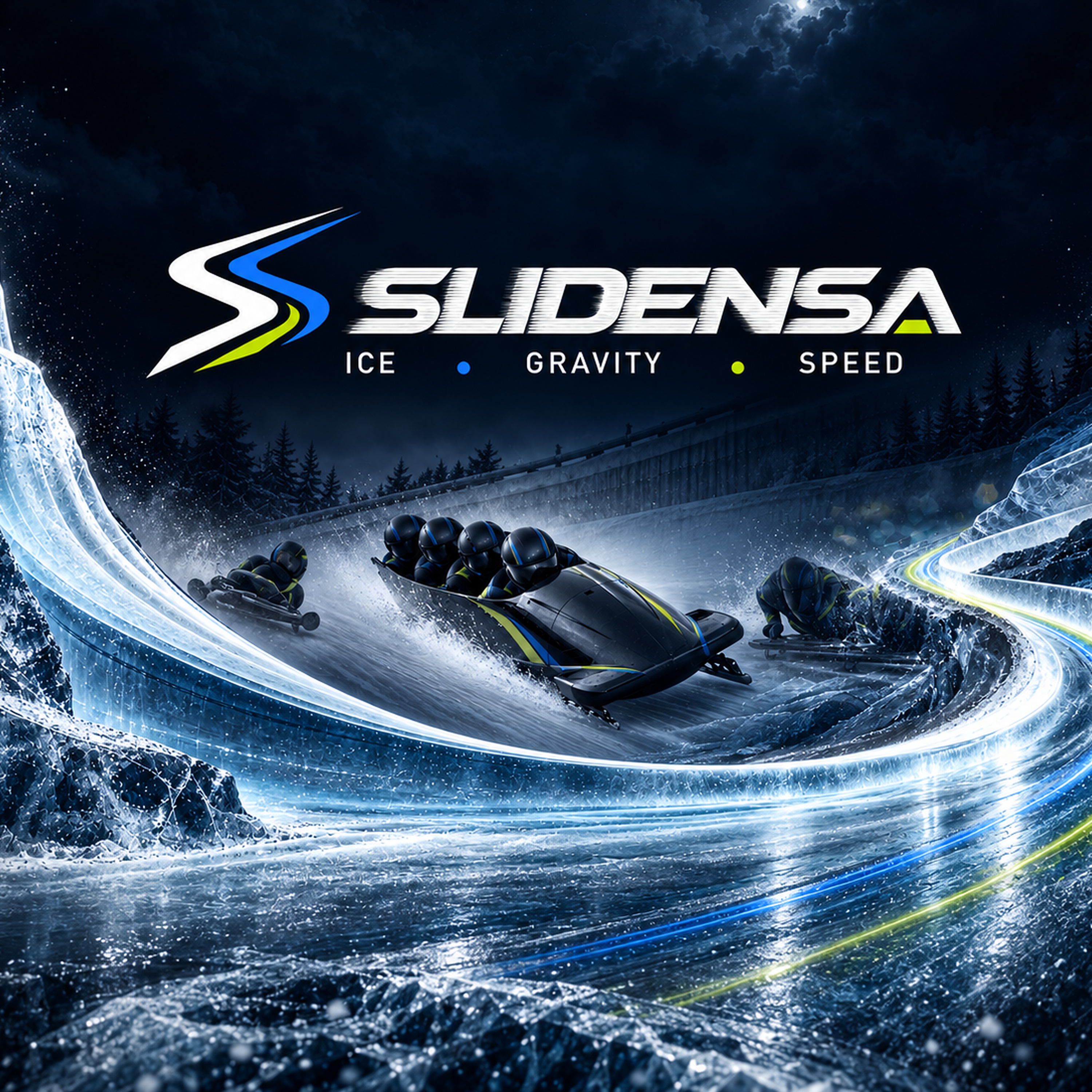
Listen now · 1 min 39 sec
Introducing Slidensa.
A road race before there were three sports. Movements too small for television to show. Six racetracks hidden inside less than three kilobytes. Start here.
Follow the show
Listen wherever you get podcasts.
Episodes one to fifteen and the trailer are out now. Follow the show to get each new story as it is released.
Season one · The fastest way down
The first stories.
Long-form documentaries for curious listeners. No knowledge of the sports—or the game—is required.
-
01 32 min 33 sec
Two Toboggans, a Plank and a Garden Rake
A postman, an Australian cricketer, several competing inventors and the improvised machine that became bobsleigh. Transcript and sources -
02 37 min 21 sec
The Racetrack That Fit in 3 Kilobytes
What a 1987 computer game preserved—and discarded—when it squeezed six tracks into 2,907 bytes. Transcript and sources -
03 32 min 48 sec
How Do You Steer a Sled with No Steering Wheel?
The ropes, runners, calves, shoulders and nearly invisible movements that point a sled through a corner. Transcript and sources -
04 34 min 47 sec
Head First
In 1887 one rider lay down and went head first down the Cresta Run. Within four winters, everyone did—and a stunt became a sport. Transcript and sources -
05 30 min 16 sec
Why Slidensa?
A 1987 game whose rivals copied your best time, a promise made at twelve, and a game built for three sports and a club of riders. Transcript and sources -
06 33 min 15 sec
Feet First
Bobsleigh and skeleton each have a famous first ride. Luge has none. How the sled everyone already knew became an international sport. Transcript and sources -
07 33 min 28 sec
The Hotelier's Bet
St. Moritz says winter tourism began with a hotelier's bet. The story is first traced almost a century later. What really made the Alpine winter. Transcript and sources -
08 31 min 0 sec
Why Is Ice Slippery?
Almost everyone learns that pressure melts ice under a blade. The numbers say otherwise, and physicists are still arguing about the real answer. Transcript and sources -
09 30 min 13 sec
The Sixteen-Year-Old
Billy Fiske won Olympic bobsleigh gold at sixteen and died after the Battle of Britain at twenty-nine. What made the victory possible, and what the legend added. Transcript and sources -
10 30 min 15 sec
What Every Sliding Game Got Wrong
Forty years of video games have tried to make bobsleigh, luge and skeleton playable, and kept meeting the same three problems. What each got right, too. Transcript and sources -
11 35 min 55 sec
The Last Track Made of Snow
Every winter a small crew builds the St. Moritz bob run from snow and water, with no printed plan. How it comes back as the same racecourse, and why each winter's rebuilt course has its own best time. Transcript and sources -
12 35 min 46 sec
America Builds a Track
To win the 1932 Winter Olympics, Lake Placid promised a bobsleigh run North America did not have. A court fight, a Berlin engineer, under five months of building, and a fortnight of crashes. Transcript and sources -
13 34 min 56 sec
The Boxer Who Rode Once
Eddie Eagan won Olympic boxing gold in 1920 and bobsleigh gold in 1932, after one dinner and a few weeks in a sled. Whose medal was it, and who else has reached a sled from somewhere unexpected. Transcript and sources -
14 34 min 42 sec
Brothers, an Earl and a Greengrocer
Skeleton was raced at the Olympics only twice before 2002, both times on the Cresta Run. An American beat his brother in 1928; twenty years later that brother lost to the town's greengrocer. Transcript and sources -
15 35 min 6 sec
Ice Bricks
At Garmisch in 1936 the bob run's curves were built from slabs of lake ice, laid like bricks. A policeman without goggles, a sled that finished without its crew, and a steel-sled family that kept coming second. Transcript and sources