
Before We Start
Skeleton is the one where they go head first.
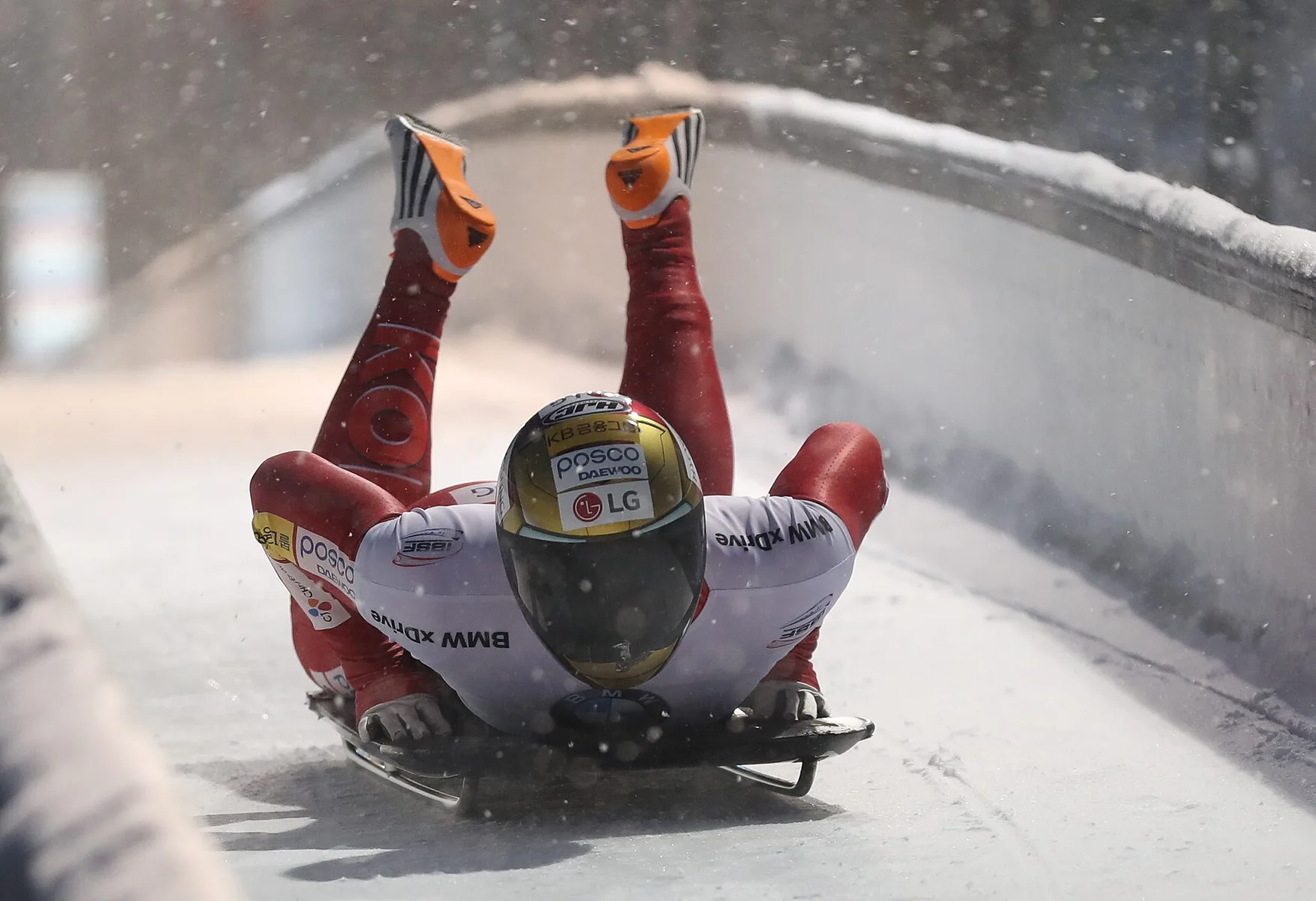
You sprint thirty metres bent double, pushing a steel tray. You dive onto it on your stomach. Then you lie there, chin a few centimetres above the ice, arms pinned to your sides, and let gravity take you down a mile of refrigerated concrete at up to 145 kilometres an hour. You steer with your shoulders and knees. There are no brakes. When you get to the bottom you sit up and drag your feet.
It is the oldest of the three sliding sports, and the one that was thrown out of the Olympics for half a century because only one track in the world could hold it. It came back in 2002 and has produced, per medal, more good stories than any other event at the Winter Games.
This is an easy read on purpose. Chapters are short. Where the facts are disputed, the notes at the back say so.
Chapter 1: A Bet, a Road and a Committee
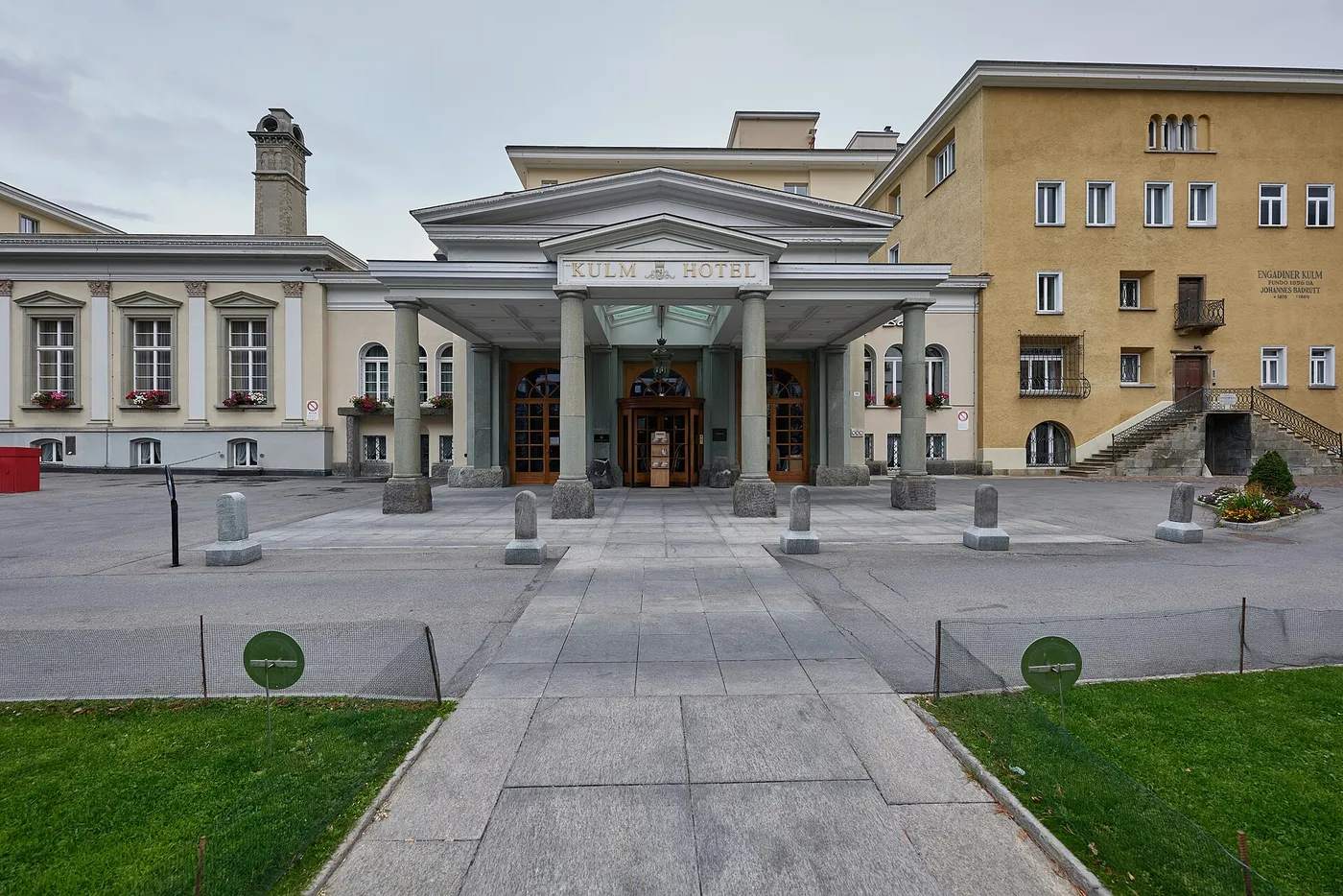

In 1864 a hotelier in St. Moritz named Johannes Badrutt made four English summer guests a wager: come back in December, and if you do not enjoy the winter, the stay is free. They came and stayed until Easter. The Alpine winter holiday had been invented, and the English had a problem. There was nothing to do.
They solved it, at first, by stealing sleds. Local delivery boys used small wooden sledges to move goods around the village; the guests borrowed them and raced down the streets. Sixty kilometres away, in Davos, English tuberculosis patients were doing the same, and in February 1883 they staged the first international race down the post road to Klosters.
St. Moritz took this badly. In the winter of 1884-85 a group of Kulm Hotel guests calling themselves the Outdoor Amusements Committee, driven by a Major William Bulpett and bankrolled by the Badrutt family, built a run of their own. A twenty-two-year-old local surveyor named Peter Bonorand laid it out. It ran from just below the hotel, past the hamlet of Cresta, down towards Celerina. Three quarters of a mile, a hundred and fifty-seven metres of drop, ten named corners.
They called it the Cresta Run and, on 16 February 1885, invited Davos to a race on it. Davos won. The celebrations in the Kulm’s Sunny Bar were said to outdo anything ever seen in Davos, which is the most St. Moritz thing that has ever happened.
Chapter 2: Mr Cornish Lies Down
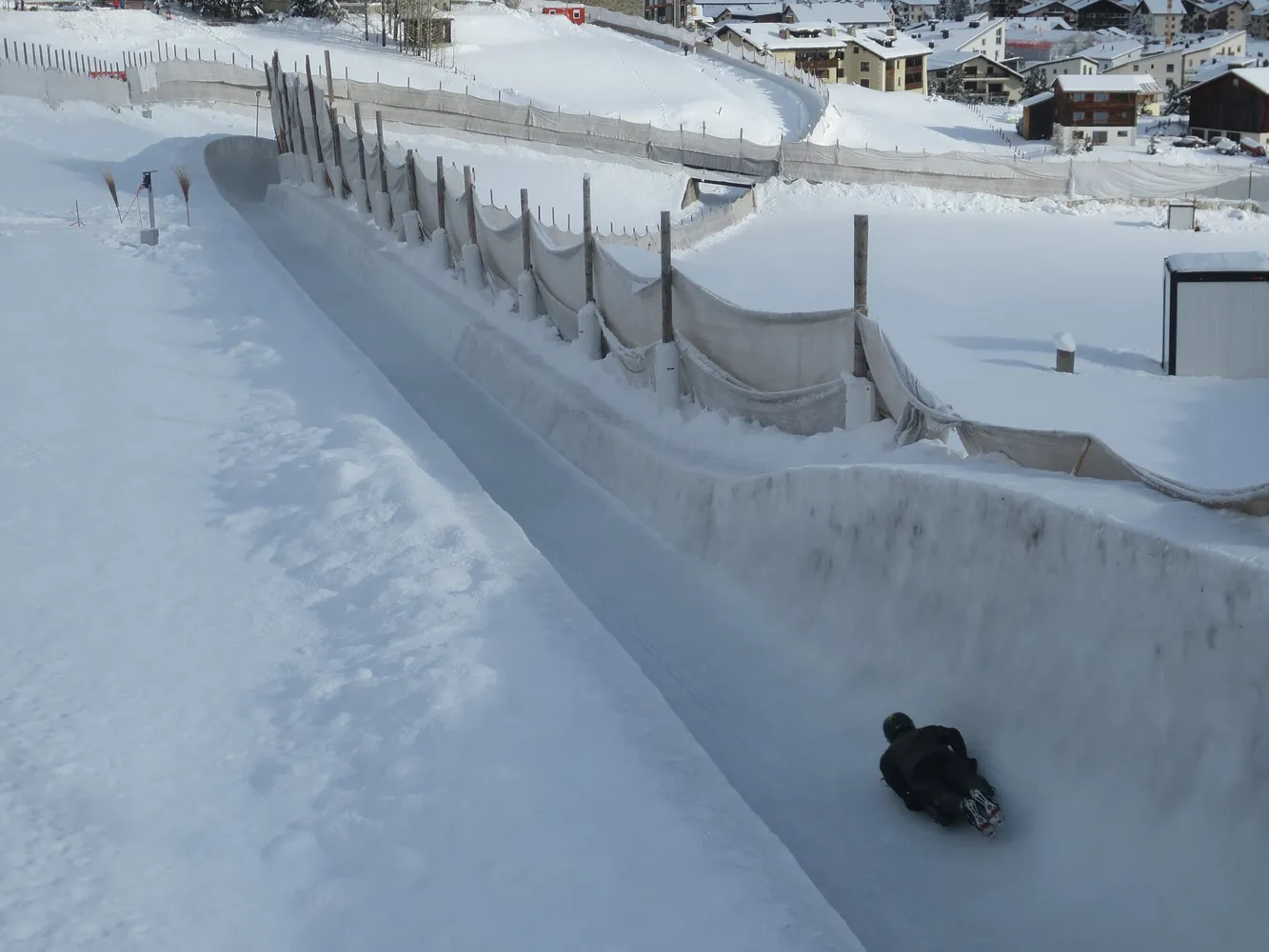

For its first two winters, everyone rode the Cresta sitting up, feet forward, the way children still do. Then, at the 1887 Grand National, a rider named Cornish lay flat on his stomach and went down head first.
He finished fourteenth. It did not matter. Within a year everyone was doing it, except for women, who continued to ride side-saddle and won their own races that way for another decade. By 1890 head-first was simply how the Cresta was ridden. In Davos, the following winter, an American named L. P. Child won the big race the same way, and the two towns have politely disputed the birthplace of skeleton ever since.
The sled changed with the position. Child had brought over a low American sled with metal runners. Then, in 1888, Bulpett and a local blacksmith named Christian Mathis built a toboggan that was nothing but a steel frame, two runners and a pad. It looked like the bones of a sled. The word “skeleton” attached itself and never left.
That, at least, is one story. The federation’s official history says an Englishman named Child unveiled the metal sled in 1892. The Cresta’s own records say Child was American and the sled came four years earlier. A third theory holds that “skeleton” is a garbling of kjælke, the Norwegian word for a sled. No one has found a document to settle it. The bony frame is the explanation you can see with your own eyes, so this book goes with that.
The club
The St. Moritz Tobogganing Club was founded in 1887 to run the thing, and it still does, in English, on ice that is rebuilt by hand from snow every autumn. There are two starts. Beginners go from Junction, opposite the clubhouse, a third of the way down. Experts go from Top. Riders steer by sliding their weight along the sled and brake with steel rakes on the toes of their boots. About one ride in twelve ends in a fall. Anyone who falls at the corner called Shuttlecock is automatically a member of the Shuttlecock Club and may buy the tie.
In 1929 the committee banned women. The reasons given were injury and a belief, seriously held, that riding could cause breast cancer. The ban lasted eighty-nine years. In 2018 the members voted to lift it, and that winter a nineteen-year-old named India Ford went down, followed by her three sisters and her mother.
Chapter 3: Brothers, an Earl and a Greengrocer
The Cresta got to host the Olympics twice, for the simple reason that the Winter Games came to St. Moritz twice and there was nowhere else on earth to hold a skeleton race.
1928
On 17 February 1928 ten riders from six countries went down the Cresta three times each. The winner was Jennison Heaton, an American. Second, one second behind, was his younger brother John, riding with a recently broken wrist. Third was David Carnegie, the eleventh Earl of Northesk. Jennison also won a silver in the bobsleigh that week. His winning sled hangs today in a St. Moritz hotel, and an American air force general rode it down the Cresta every year until his eightieth birthday.
1948
Twenty years later the Games returned, and so did John Heaton. He was thirty-nine, carried the American flag at the opening ceremony, and won silver again, twenty years after his first.
He was beaten by a greengrocer.
A thirty-nine-year-old flag-bearer, twenty years after his first silver, beaten by the man who sold the town its vegetables.
Nino Bibbia had been brought to St. Moritz from Italy at the age of three. He sold fruit and vegetables in the town. He had taken up the Cresta only two winters earlier, and 1948 was his first season riding from Top. He won by a second and a half, giving Italy its first Winter Olympic medal of any colour, and then went on to ride the Cresta for the rest of his life. He won more than two hundred races and eight Grand Nationals. When Italy built a track for the 2006 Games, they named a corner after him. He died in St. Moritz in 2013, aged ninety-one.
The long exile
In 1954 the International Olympic Committee met in Athens and quietly dropped skeleton. Luge would take its place from 1964. The reason recorded in the minutes was practical: skeleton could only be held when the Games were in St. Moritz, because only the Cresta could stage it. The head-first sport went back to being a private amusement for a club in a Swiss hotel, and stayed there for nearly fifty years.
Chapter 4: The Comeback

What brought skeleton back was concrete.
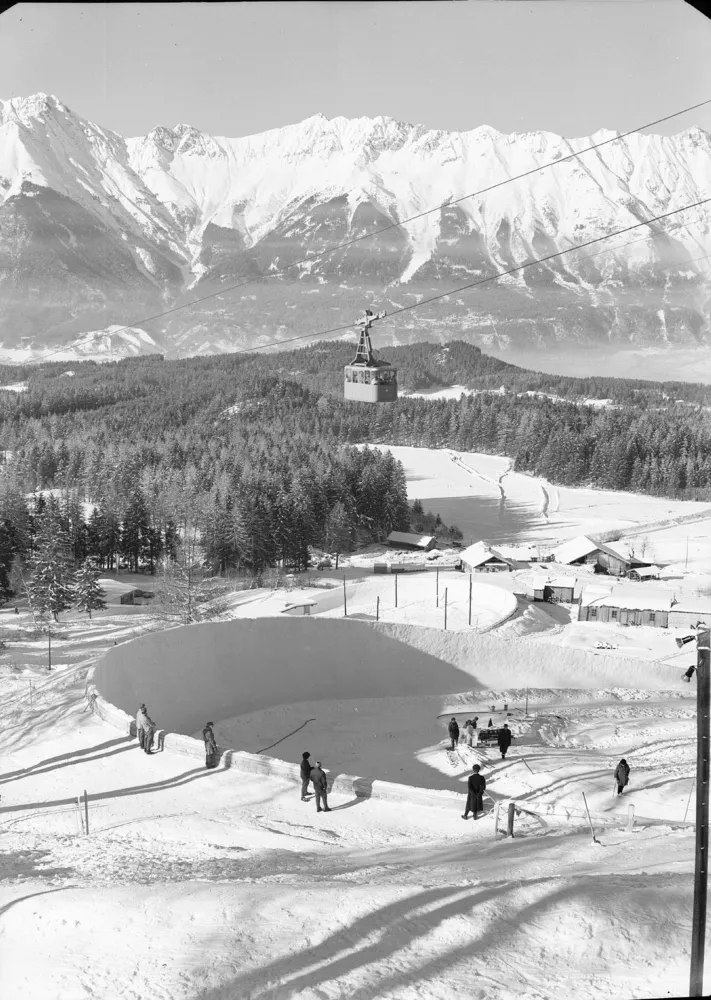
From 1969, when Königssee opened the first artificially refrigerated track, bobsleigh runs became permanent, predictable and available. Around 1970 someone built a smaller, stiffer version of the Cresta toboggan that could be ridden down a bob track without the rakes and the sliding seat. Austria, which had been racing skeleton at a place called Mürzzuschlag since 1905, took it up seriously.
In 1982 the bobsleigh federation staged the first skeleton World Championships, on the bob run at St. Moritz, not the Cresta. An Austrian named Gert Elsässer won. From 1986 there was a World Cup circuit. Women joined it in 1996, and the first women’s World Championship was held at Igls in 2000.
In October 1999 the IOC voted skeleton back onto the programme for Salt Lake City, with a women’s event for the first time. The sport had been away for fifty-four years.
Chapter 5: Salt Lake City, 2002
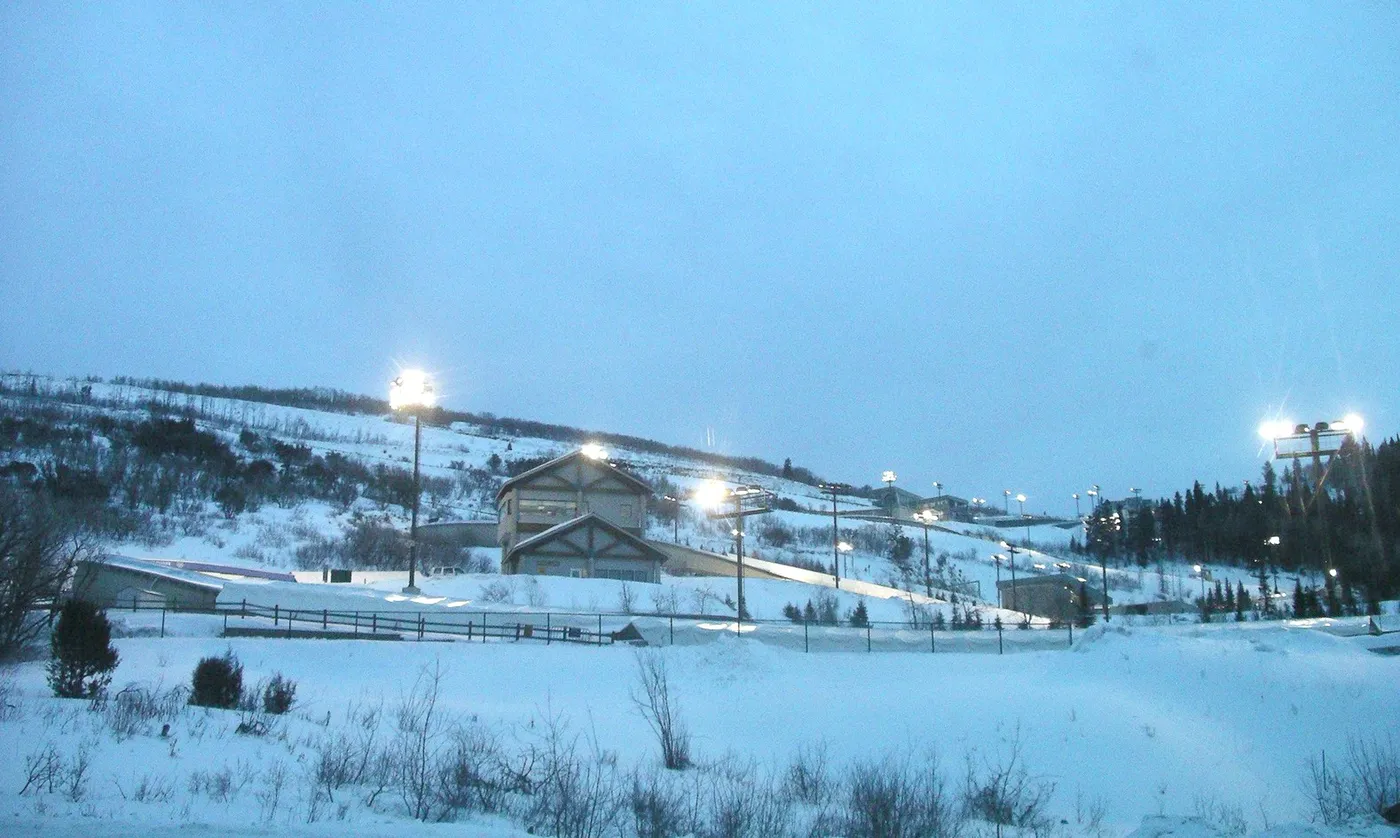

The first Olympic skeleton race outside St. Moritz was held at Utah Olympic Park on 20 February 2002, two runs, thirty-nine sliders from nineteen countries.
The men’s race was won by Jim Shea Jr, an American, by five hundredths of a second. His grandfather Jack Shea had won two speed-skating golds at Lake Placid in 1932. His father had skied at Innsbruck in 1964. Four weeks before Salt Lake City, Jack Shea, aged ninety-one, was killed when a drunk driver hit his car near Lake Placid. Jim slid with his grandfather’s funeral card tucked inside his helmet.
The first women’s Olympic skeleton champion was Tristan Gale, twenty-one, with red, white and blue streaks dyed into her hair. Second was her team-mate Lea Ann Parsley, a career firefighter from Ohio. Third was Alex Coomber, a Royal Air Force intelligence officer who had won the last three World Cups and was racing with a wrist she had broken in training ten days earlier.
Britain would win a skeleton medal at every Games for the next sixteen years, which nobody at the time would have believed.
Chapter 6: Turin, 2006
Duff Gibson of Canada won the men’s race at the age of thirty-nine, becoming the oldest individual gold medallist in Winter Olympic history. He retired the same day. His team-mate Jeff Pain, the reigning double world champion, took silver and was not entirely gracious about it.
The women’s gold went to Maya Pedersen of Switzerland. The silver went to Shelley Rudman of Pewsey, Wiltshire, and it was the only medal Britain won at the entire Games.
Rudman had been thrown out of the previous year’s World Championships for a sled that was two hundred grams overweight and had lost her funding as a result. Her village raised money for her to get to Turin, partly through a twelve-hour canoe marathon. She practised the track by lying on her sled on a table in front of a television and watching video of it. Pewsey now has an Olympic Road and a Silver Road.
Her partner, and the man who built her sled, was Kristan Bromley, a British engineer whose doctoral thesis was titled Factors affecting the performance of skeleton bobsleds. Everyone called him Dr Ice. He was the only slider on the World Cup circuit who designed and manufactured his own equipment, in a workshop in Rotherham with his brother Richard. In 2008 he became world champion on it.
Chapter 7: Vancouver, 2010
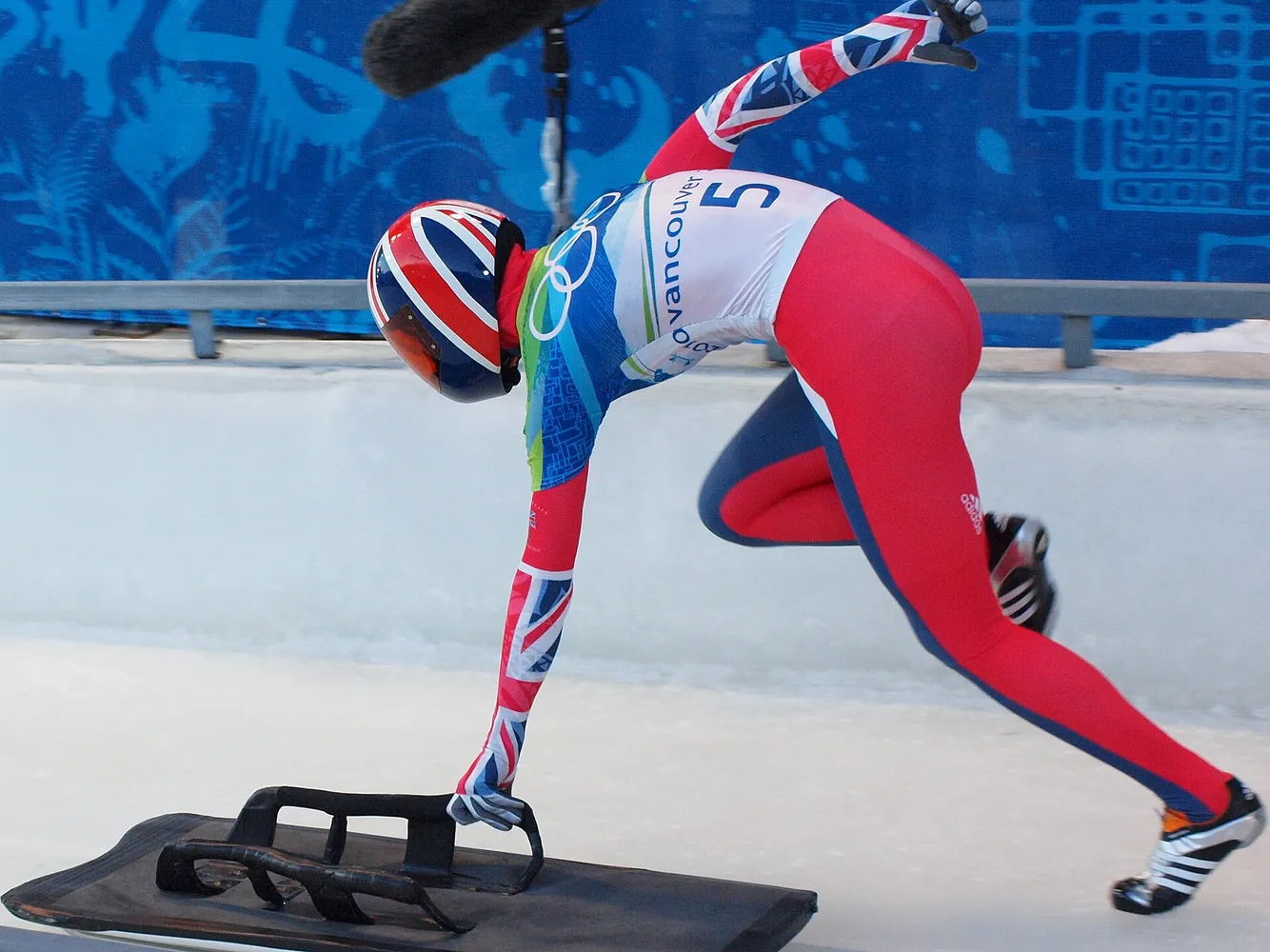

The beer
Martins Dukurs of Latvia led the men’s race after the first run and still led going into the last. Jon Montgomery of Canada, a former car auctioneer from Calgary who had wandered into a skeleton race at Canada Olympic Park eight years earlier and decided to try it, set a track record on his third run and beat him by seven hundredths of a second.
Montgomery then walked through Whistler village to the medal ceremony. Somewhere in the crowd a fan passed a full pitcher of beer over the shoulder of a Mountie. He took it and drank as he walked, while the crowd sang the national anthem. It is the most-replayed moment in the history of the sport. “If the beer is all I’m ever remembered for,” he said later, “I consider myself the luckiest fella on Earth.”
“If the beer is all I’m ever remembered for, I consider myself the luckiest fella on Earth.”
The helmet
Amy Williams, a former four-hundred-metre runner from Bath, won the women’s race by more than half a second. It was Britain’s first individual Winter Olympic gold in thirty years and, again, the country’s only medal of the Games.
The Americans protested her helmet. It had two small ridges moulded into the back, which they said were an illegal aerodynamic aid. The jury ruled the ridges were part of the helmet. Canada protested next. That was denied too. Williams called it sour grapes and went home to be made an MBE.
Her sled was called Arthur. It had been designed by two engineering students at Southampton after two hundred hours in a wind tunnel, modelled on a computer at Sheffield Hallam and built by BAE Systems, a defence contractor. Britain had no ice track of its own. It had a push-start ramp at the University of Bath, national lottery money, and a decision to spend that money on engineers. The rest of the sport was about to notice.
The Dukurs family
Martins Dukurs went home with silver. His older brother Tomass finished fourth. Their father Dainis, a former Latvian bobsleigh champion, built their sleds and ran the track at Sigulda where they had grown up. Over the next decade Martins would win six World Championships and a record eleven overall World Cup titles, and would be, by any measure, the best skeleton slider who ever lived. The Olympic gold kept getting away.
Chapter 8: Sochi, 2014
Alexander Tretiakov of Russia won the men’s race at home, with Dukurs second again. Lizzy Yarnold of Britain won the women’s race by nearly a second.
Yarnold had been a county-level heptathlete until 2008, when she answered an advertisement for a talent-search programme called Girls4Gold. About nine hundred women were tested. Four were sent to skeleton. She first slid at Lillehammer in March 2009 and was Olympic champion five years later. Her sled was called Mervyn, after an insurance underwriter who had backed her early on, and had been engineered by McLaren, the Formula One team. One of the engineers, James Roche, later married her.
Two Americans missed the podium by four hundredths of a second each. Katie Uhlaender, in her third Games, was fourth in the women’s race. John Daly was in fourth place with one run left when his sled popped out of the start grooves and he skidded off the line. He retired that week.
In November 2017 the IOC stripped Tretiakov and the women’s bronze medallist Elena Nikitina of their medals over Russia’s state doping programme, and banned them for life. Uhlaender was told she would get a bronze. She was half asleep when the call came and asked whether she was dreaming. Ten weeks later, three days before the next Games, the Court of Arbitration for Sport overturned the bans for lack of individual evidence and gave the medals back. Uhlaender finished fourth again.
Chapter 9: PyeongChang, 2018
Iron Man
Yun Sung-bin had been sent to a skeleton trial in 2012 by his school PE teacher. He turned up in shorts and slippers, he said later, without a clue what the sport was, and finished fifteenth out of thirty. They took him anyway. He ate eight meals a day to put on ten kilograms and was on the national team within three months. At Sochi, aged nineteen, he came sixteenth. At St. Moritz in 2016 he beat Dukurs for the first time.
At PyeongChang, on his home track, wearing a helmet painted as Iron Man because, he explained, sliding looked like Iron Man flying, he set track records in three of four runs and won by 1.63 seconds. It is the largest winning margin in Olympic skeleton and the biggest in any sliding event since 1972. No Asian athlete had ever won a medal in any sliding sport. Korea calls him the Emperor.
Dukurs was fourth, eleven hundredths from bronze. Tomass was fifth. Dom Parsons, a British PhD student in mechanical engineering, took the bronze.
The dizzy champion
Lizzy Yarnold arrived with a chest infection and a flare-up of an inner-ear disorder that left her dizzy after her first run. She changed into a lighter suit and carried on. After three runs she trailed Austria’s Janine Flock by two hundredths of a second. She set a track record on the fourth and won by nearly half a second. She was the first skeleton slider to defend an Olympic title and the first British Winter Olympian to defend any title at all. Her team-mate Laura Deas took bronze. Three British medals in a day, in a sport the country had no track for.
Three British medals in a day, in a sport the country had no track for.
The Americans protested again. This time it was the suits: British skinsuits with fine ridges across the fabric, derived from work done for British cycling, that broke up the airflow. The federation inspected them and found nothing illegal. Yarnold’s own comment was that the British sliders never saw the new kit until the Games, and as soon as they had finished racing it disappeared into someone’s bag.
She retired a few months later.
Chapter 10: Beijing, 2022
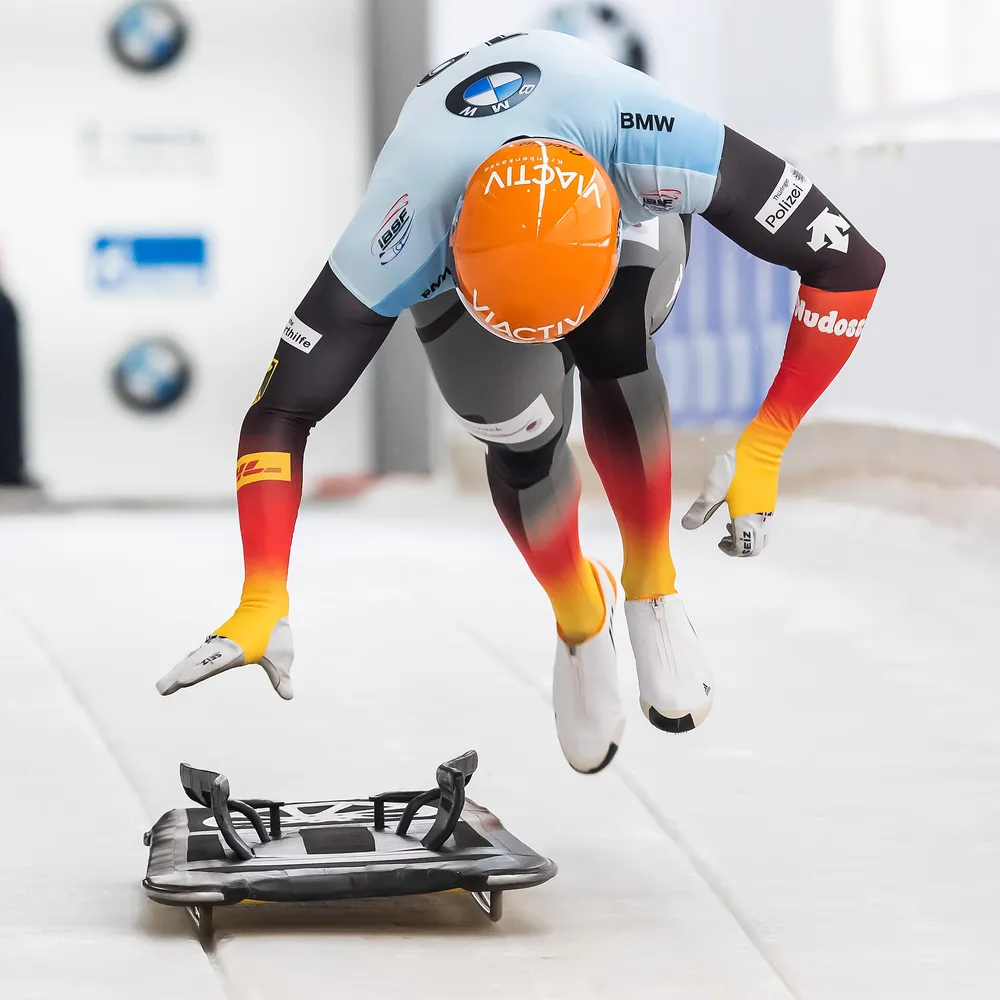

Germany, which had never won an Olympic skeleton gold, won both. Christopher Grotheer led a German one-two in the men’s race. In the women’s, twenty-one-year-old Hannah Neise was eighth after the first run and then set the fastest time in each of the next three. China’s Yan Wengang took bronze on home ice, Australia’s Jaclyn Narracott took silver, and Kimberley Bos won the Netherlands’ first skeleton medal.
Britain won nothing. Its best slider was fifteenth. Commentators said the British kit was bleeding speed all the way down the track, and one of the sliders agreed on air. The lottery had spent more than six million pounds on the programme in the cycle. Six months later British skeleton hired a new performance coach: Martins Dukurs, who had just retired at thirty-eight with six world titles and no Olympic gold.
Chapter 11: Cortina, 2026
Skeleton returned to Italy on a new track built on the site of the old Cortina run, the one Nino Bibbia would have known. A mixed team event had been added, one woman and one man each taking a single run with the times combined.
A week before the Games the federation banned Britain’s new helmets, which had a ridged, protruding rear. The British appealed to the Court of Arbitration for Sport and lost, and the team went back to the helmets it had worn all season.
It did not matter. Matt Weston, coached by Dukurs, set a track record on every one of his four runs and won the men’s race by nearly nine tenths of a second. It was the first British men’s skeleton gold. Two days later he and Tabitha Stoecker won the inaugural mixed team event, making him only the second Briton ever to win two golds at one Winter Games. Germany’s Axel Jungk and Grotheer took the minor medals in both.
The women’s race went to Janine Flock of Austria. She was thirty-six and at her fourth Games. In 2018 she had led for three runs and finished fourth by two hundredths. In Cortina she led from the first run to the last. It was Austria’s first skeleton gold and she was the oldest woman ever to win a skeleton medal.
Ukraine’s Vladyslav Heraskevych was disqualified before the race for a helmet bearing the faces of twenty-four Ukrainian athletes killed in the war, under the rule forbidding political statements. The federation found his helmet a problem and Britain’s helmets a problem in the same week, for very different reasons.
Chapter 12: How It Actually Works

The sled
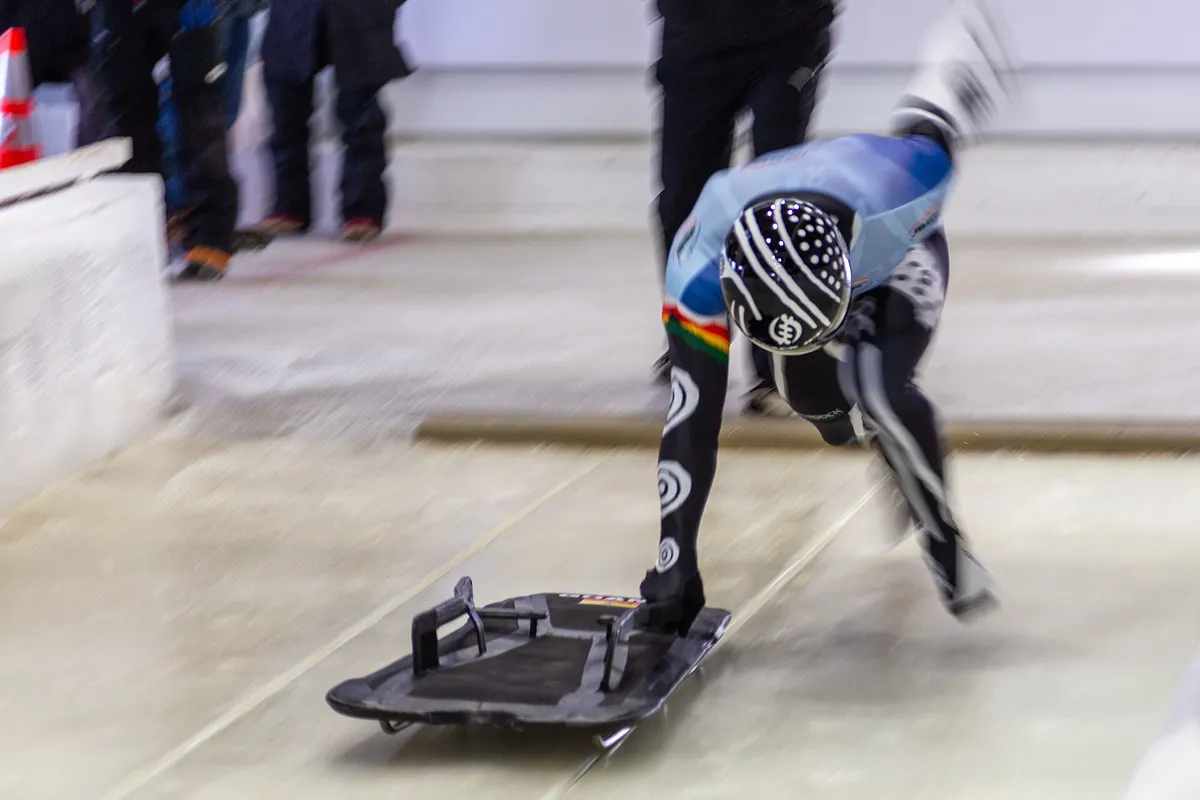
A skeleton sled is a steel frame with a steel saddle bolted to it and wrapped in tape so the rider is not cut. Underneath is a fibreglass or carbon belly pan that channels the air. Two runners, four bumpers at the corners for taking the walls, and two handles used only for the push. There is no steering mechanism and no brake, and the rules say so in as many words.
The runners are the only thing the rider is not allowed to be clever about. Since a rule change in the 2000s every runner in the sport is made from the same standard steel from a factory designated by the federation. You may grind it into a shape. You may not coat it, plate it, or replace it. Before each run it is checked against a reference runner left out in the air: if yours is more than four degrees warmer, you are out. This is the same lesson luge learned at Grenoble in 1968.
Sled and rider together may weigh no more than a hundred and twenty kilograms for men and a hundred and two for women. Ballast is allowed, but only bolted to the sled. Weight on the body is banned, which is the opposite of the luge rule.
The start
The start is a thirty-metre sprint, bent double, one hand on the sled, in shoes with at least two hundred and fifty tiny spikes in the sole. Then the rider dives on. The best men cover the first fifty metres in about four and a half seconds. This is why skeleton recruits sprinters and hurdlers: a study of British sliders found that speed before the dive, and the quality of the dive itself, explained nearly all of the difference between a good start and a bad one.
Steering
The rider lies with arms at the sides and chin about five centimetres above the ice. To turn left, press the right shoulder into the sled, or the left knee, or both. In a straight, tilting the head a fraction changes the airflow enough to nudge the sled across the track. A toe dragged on the ice will turn you hard, at a price in speed, so good sliders use small quick taps.
There is no brake until the finish line. After it, the track runs uphill, the rider sits up and puts both feet down, and if that is not enough there is a foam mat. Television almost never shows this part.
Speed and safety
Racing speeds are 130 to 140 kilometres an hour, with about five times body weight in the big corners. The record is 146.4, set at Whistler in 2010. Skeleton is actually the slowest of the three sliding sports, because its round runners are blunter than a luge’s blades and because a helmet leads the way into the wind.
It is also, by the numbers, safer than it looks. The rider’s centre of gravity is a few centimetres off the ice, the sled weighs less than forty-five kilograms, and the overhanging curves of a modern track make it very hard to leave. John Daly’s explanation was simpler: if a bobsleigh rolls on you, that is five hundred pounds.
“If the bobsled rolls over on you, that’s five hundred pounds.” The real toll is quieter. Repeated small impacts produce what sliders call sled head, a fog of headaches and imbalance, and the Canadian team learned in 2010, after two women retired with concussions, to stop doing six runs a day.
The helmets
Because a skeleton helmet is a smooth fibreglass dome that leads the way into the air, its shape is regulated to the millimetre, and because it is a smooth fibreglass dome, it is also a canvas. Yun Sung-bin’s Iron Man is the famous one. There have been bald eagles, moose antlers, Dracula and a painted turtle that Jon Montgomery commissioned after rescuing one from a road in British Columbia. A good helmet painter charges more than a thousand dollars and says it is still not enough.
Chapter 13: Why Would Anyone Do This
Every skeleton slider is asked this question, usually by a journalist who has just watched them come through the finish with their face a hand’s width from the ice.
Katie Uhlaender’s answer was that it is basically a water slide, but epically fast. Lizzy Yarnold’s was that it is like a roller coaster, terrifying and exciting. Jon Montgomery, on seeing the seven hundredths that made him champion, said it felt like putting his finger in a light socket. Laura Deas said that British sliders had learned to innovate because they had no track at home and had to make up the difference somewhere. Prince Harry, after riding a public run at Whistler in 2024 at ninety-nine kilometres an hour, said everybody should do it.
John Daly, at the age of forty, asked the question one more time at Cortina in 2026, gave the best answer the sport has. “If I knew that,” he said, “I probably wouldn’t be out here.”
“If I knew that, I probably wouldn’t be out here.”
A Timeline
| Year | What happened |
|---|---|
| 1864 | Badrutt’s winter bet with four English guests, St. Moritz. |
| 1883 | First international toboggan race, Davos to Klosters. |
| 1884–85 | Cresta Run built below the Kulm Hotel. |
| 1885 | 16 February: first Grand National. Davos wins. |
| 1887 | Cornish rides head first. St. Moritz Tobogganing Club founded. |
| 1888 | First steel “skeleton” toboggan built at St. Moritz. |
| 1905 | First skeleton outside Switzerland, at Mürzzuschlag, Austria. |
| 1928 | St. Moritz Olympics: Heaton brothers gold and silver. |
| 1929 | Cresta bans women. |
| 1948 | St. Moritz Olympics: Nino Bibbia gold, John Heaton silver again. |
| 1954 | IOC drops skeleton in favour of luge. |
| 1970s | Bob-track skeleton sled developed. |
| 1982 | First World Championships, St. Moritz. Gert Elsässer wins. |
| 1986–87 | First World Cup season. |
| 1999 | IOC restores skeleton for 2002, men and women. |
| 2002 | Salt Lake City: Jim Shea Jr and Tristan Gale. |
| 2006 | Turin: Duff Gibson gold at 39. Shelley Rudman’s village silver. |
| 2010 | Vancouver: Montgomery’s beer, Williams’s helmet, Dukurs’s first silver. |
| 2014 | Sochi: Yarnold gold. Tretiakov gold, later stripped, then restored. |
| 2018 | PyeongChang: Yun’s Iron Man, Yarnold’s second gold, the skinsuit row. Cresta admits women. |
| 2022 | Beijing: German double. Britain shut out. Dukurs retires and joins Britain as coach. |
| 2026 | Cortina: Weston two golds, Flock gold at 36, first mixed team event. |
Notes on Sources and Disputed Facts
This book was written from three research fact sheets kept alongside it in the research/ folder. Each claim there carries a source link. The main sources were the St. Moritz Tobogganing Club’s history pages and the Cresta museum, the International Bobsleigh and Skeleton Federation’s rules and news pages, Olympics.com, Olympedia, Wikipedia in English, UK Sport, the British federation, and contemporary reporting from the BBC, CBC, ESPN, NPR, the Korea Herald and others.
Where sources disagree, this book has chosen the plainer or vaguer version. The disagreements worth knowing about:
- Which Badrutt. Most secondary sources say Caspar Badrutt backed the Cresta Run. The Cresta museum says his brother Peter, who ran the Kulm Hotel in 1884. This book names only “the Badrutt family”.
- The first Grand National. The club says 16 February 1885. The museum says 16 January. This book follows the club.
- The name and the metal sled. The federation says an Englishman named Child built a metal sled in 1892. Cresta records say Child was American, brought a wooden sled in 1887, and that Bulpett and a blacksmith built the first steel frame in 1888. The Norwegian etymology has no documentary support.
- 1948 field size. Given as fifteen riders from six nations, or thirteen from five.
- The Cresta vote on women. Reported as July 2018 by a contemporary account and December 2018 by others.
- Bibbia’s win count. Given as 231, “over 200”, and “400 prizes” by different sources.
- Sled weight rules have changed several times. The figures in Chapter 12 are the 2025 rules.
- Amy Williams’s sled has been credited to Southampton University, BAE Systems and Sheffield Hallam. All three had a hand in it. Kristan Bromley’s company is sometimes credited too; the primary sources do not support that.
- The British medal streak. Often described as “every Games since 2002”. It was broken in 2022.
- Matt Weston’s winning time. Most sources give 3:43.33; one gives 3:43.44.
Corrections welcome. The fact sheets are the place to record them.